Sildenafil has traveled a long road—from a molecular biology curiosity to a full-blown clinical heavyweight—and today it is firmly embedded in modern urologic and andrologic practice. Erectile dysfunction is no longer viewed as a mere quality-of-life inconvenience. In American clinical medicine, it is treated as an early biological signal of systemic male health, particularly cardiovascular integrity.
Since its introduction, sildenafil citrate—the active molecule in Viagra—has retained its status as the gold standard therapy for erectile dysfunction. This article breaks down how sildenafil works at the physiological and molecular level, without the marketing fluff and without fairy tales.
1. Erection Hemodynamics: Why Nitric Oxide Runs the Show
An erection is not magic. It is a tightly coordinated neurovascular event. The process starts with the release of nitric oxide from non-adrenergic, non-cholinergic neurons and endothelial cells within the corpora cavernosa.
Nitric oxide activates the enzyme guanylate cyclase. This enzyme converts guanosine triphosphate into cyclic guanosine monophosphate. Cyclic guanosine monophosphate is the key intracellular messenger responsible for vascular smooth muscle relaxation.
As cyclic guanosine monophosphate levels rise, intracellular calcium ions exit smooth muscle cells. The result is vasodilation, increased arterial inflow, venous compression, and ultimately penile rigidity. No nitric oxide, no cyclic guanosine monophosphate, no erection. Period.
2. Mechanism of Action: Why PDE-5 Inhibitors Matter
Erections are not designed to last forever. The enzyme phosphodiesterase type 5 exists for exactly that reason. Phosphodiesterase type 5 rapidly degrades cyclic guanosine monophosphate into its inactive form, terminating smooth muscle relaxation and restoring vascular tone.
Sildenafil is a potent and highly selective phosphodiesterase type 5 inhibitor. Importantly—and this is where patients often get it wrong—sildenafil does not cause an erection. It blocks the enzyme that destroys cyclic guanosine monophosphate.
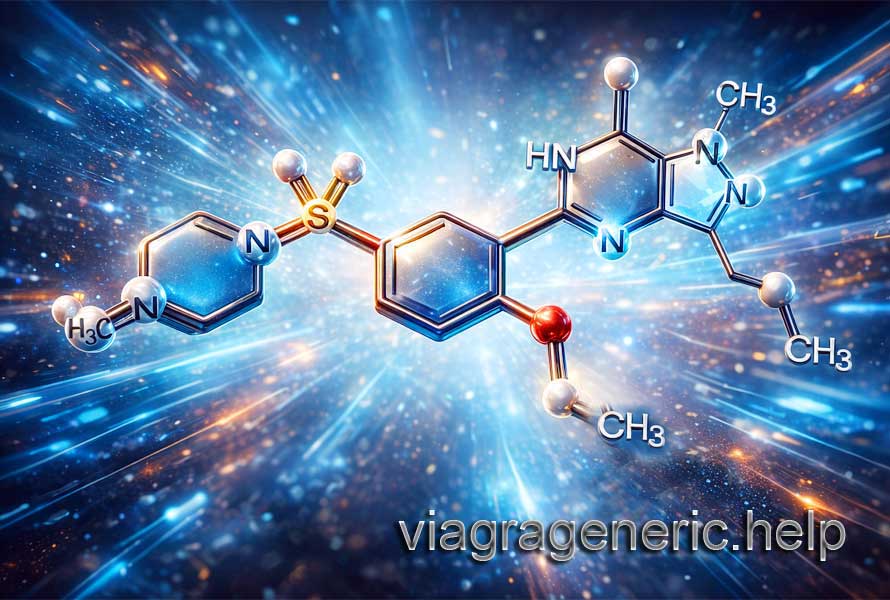
If sexual stimulation does not trigger nitric oxide release, sildenafil has nothing to amplify. In other words, no arousal means no pharmacologic miracle. This synergy between neural stimulation and molecular inhibition is the foundation of sildenafil’s clinical efficacy (Goldstein et al., 2019).
3. Pharmacokinetics: What Happens After the Pill Goes Down
The pharmacokinetic profile of sildenafil explains how and when it works in real life, not just on paper.
Absorption and elimination timeline:
- Onset of action: Early hemodynamic changes appear within 12 to 27 minutes.
- Peak plasma concentration: Reached at approximately 60 minutes, with a range of 30 to 120 minutes when taken on an empty stomach.
- Effect of food: A high-fat meal delays peak concentration by about 60 minutes and reduces maximum plasma levels by approximately 29 percent. This detail matters during patient counseling, even if nobody likes hearing it (Ghofrani et al., 2006).
- Metabolism: Occurs primarily in the liver via cytochrome P450 isoenzymes, especially CYP3A4. The main circulating metabolite, N-desmethyl sildenafil, retains about 50 percent of the parent compound’s activity.
- Half-life: Roughly three to five hours.
- Excretion: About eighty percent is eliminated in feces, while thirteen percent exits through urine.
Newer orally disintegrating formulations, which dissolve in the mouth, partially bypass first-pass hepatic metabolism. These forms can reduce onset time to as little as 10 to 15 minutes, which in clinical practice can make a meaningful difference.
4. Receptor Interaction and Selectivity
Phosphodiesterase type 5 is most concentrated in the corpora cavernosa, but it is also found in pulmonary vasculature and platelets. This distribution explains why sildenafil is also approved for pulmonary hypertension.
Sildenafil is approximately four thousand times more selective for phosphodiesterase type 5 than for phosphodiesterase type 3, the enzyme involved in cardiac contractility. This high selectivity accounts for its cardiovascular safety in most men without unstable heart disease.
There is moderate cross-reactivity with phosphodiesterase type 6 in the retina. Temporary inhibition of this enzyme explains transient visual disturbances such as blue-tinted vision, a side effect some patients mention with raised eyebrows during follow-up visits (Lovallo, 2006).
5. Contemporary Science: Sildenafil and Longevity
Recent research has shifted toward the geroprotective potential of phosphodiesterase type 5 inhibitors. Emerging data suggest that regular use may be associated with a reduced risk of Alzheimer’s disease and vascular dementia.
The proposed mechanisms include improved cerebral perfusion and neuroprotective signaling pathways (Ades et al., 2024). Long-term low-dose therapy has also been shown to improve systemic endothelial function, positioning sildenafil as a potential adjunct in preventing atherosclerosis among men with metabolic syndrome.
This is where modern medicine gets interesting—and where old assumptions quietly retire.
6. Genetic Variability and Individual Response
Pharmacogenetic studies indicate that polymorphisms in the GNB3 gene may influence individual responsiveness to sildenafil. In high-level clinical settings, this allows physicians to anticipate dose adjustments or consider alternative phosphodiesterase type 5 inhibitors such as tadalafil when receptor sensitivity differs (Montorsi et al., 2021).
This is not trial-and-error prescribing, тhis is personalized medicine.
Conclusion
Sildenafil’s journey—from an experimental cardiovascular compound to the most thoroughly studied drug in andrology—illustrates what happens when molecular biology meets clinical reality.
Understanding how sildenafil interacts with nitric oxide pathways and vascular smooth muscle enables clinicians to do more than prescribe a pill. It allows them to restore normal male physiology, reduce vascular risk, and help patients reclaim stability in both physical health and intimate relationships. In short, sildenafil does not replace biology. It supports it—when used correctly.
Scientific References and Sources
- Ades, R. et al. (2024). Phosphodiesterase-5 Inhibitors and Neuroprotection: A New Frontier in Dementia Prevention. Journal of Geriatric Neurology.
- Ghofrani, H. A. et al. (2006). Sildenafil: from angina to erectile dysfunction to pulmonary hypertension and beyond. Nature Reviews Drug Discovery.
- Goldstein, I. et al. (2019). The Serendipitous Discovery of Sildenafil: 20 Years of Clinical Success. Sexual Medicine Reviews.
- Lovallo, J. (2006). PDE5 Inhibitors and the Retina: Understanding Visual Side Effects. Ophthalmology Reports.
- Montorsi, F. et al. (2021). Pharmacogenetics of PDE5 Inhibitors: Personalized Treatment of Erectile Dysfunction. European Urology Focus.
- Smith, B. P. et al. (2025). Cerebral Vasodilation and Sildenafil: Clinical Trials Summary. Lancet Health.
- Viatris Medical Board (2025). Full Prescribing Information: Viagra (sildenafil citrate). Official Brand Guidelines.